Guides  ›  Eyeing a launch
Eyeing a launch

New launch, resale or EC?

Answer four questions about your own situation, then compare the routes on the facts.
By Jimmy Sum  |  CEA Reg No: R026725F  |  Updated November 2026
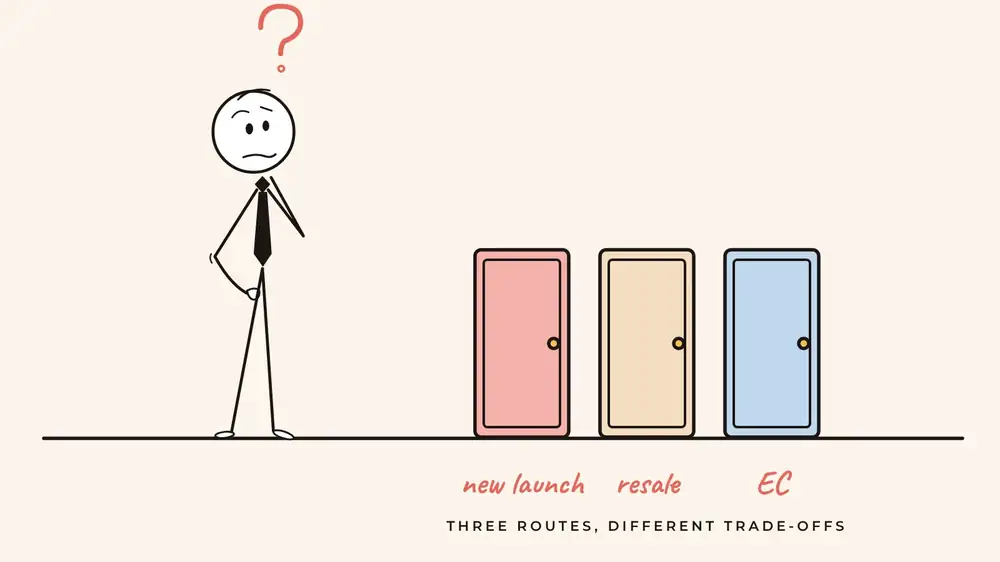
Line-art stickman thinking in front of three different doors for a new launch, a resale home and an executive condo
Three routes to your next home, each with its own trade-offs.

Four questions to start

Tap Yes or No for each. This is a guide to your thinking, not a verdict.

Do you need to move into your next home within about two years?
Would you rather see the actual home before you commit?
Is your household eligible for an executive condo, including the income limit?
Are you comfortable with a long occupation period before you can sell freely?
What your answers suggest
Answer all four to see a lean

Tap Yes or No on each question.

The three routes

New launch
Usually true

The home is built after you buy. You choose from plans and a showflat, pay in stages, and move in when it is ready.

Watch for

The wait, and where you live in the meantime. The showflat is a model, so check what is included.


Line-art stickman explaining beside a tall condo under construction with a tower crane
A new launch is built after you buy, so you wait before you move in.
Line-art stickman with a happy expression beside an existing condo with a key, showing you can view a resale home before you buy
With a resale home, you can walk through the real one before you decide.

How a new launch purchase works

The details differ by project, so use this as a map, and check the actual terms in the sales documents.

1
Register and view
Many launches ask you to register or book a time. Take your numbers with you.
2
Pay a booking fee when you choose a unit
This is usually a percentage of the price, in cash, and the terms are in the option.
3
Sign the sale and purchase agreement
Within a set period. This is when you should have your loan and your cash lined up.
4
Pay in stages as the building progresses
Much of the price is paid through progressive payments tied to construction.
5
Wait for completion and collect your keys
This can take years, so plan where you live in the meantime.

Paying for it: how the loan behaves

The route you choose changes how the loan and the payments work, and this surprises many first-time upgraders.

Resale

The loan is drawn in full when you complete, so the instalments start at the full amount.

Your cash needs are front-loaded: option fee, exercise, then completion.

New launch

The loan is drawn in stages as construction progresses, so the bank sends money to the developer in steps.

You pay interest only on what has been drawn, so the instalment grows over the years.

You may need to pay rent for your current home or cover two sets of costs while you wait.

Ask each bank

How the loan is drawn for an uncompleted project, how the instalment grows, and whether there are charges if completion is delayed. Check these in writing before you sign.

What changed for new ECs in 2026

Rules for new EC sites

For new EC sites tendered from 8 May 2026, the minimum occupation period is 10 years instead of 5, and full privatisation moves from 10 to 15 years.

The deferred payment scheme is removed, so you pay in the normal stages. The first-timer priority period is longer, so check whether you qualify in the first window.

A few projects already in the pipeline were exempted. Check the rules for the specific project with HDB, and confirm your own eligibility.

Read: Condo or EC

How a resale purchase works

1
View, and make an offer
You can see the actual home. Check the condition, the lease, and the maintenance fee.
2
Pay an option fee for an option to purchase
This is commonly a small percentage of the price, in cash.
3
Exercise the option within the time given
Usually around two weeks, with a further payment, so your cash and loan need to be ready.
4
Complete the purchase
Usually within a couple of months of exercising the option.
Check the remaining lease

For a leasehold home, the remaining lease matters for the price, and also for your loan and how much CPF you can use. Check the terms before you make an offer.

The comparison

New launch
Resale
EC
Move in
After it is built
Usually sooner after completion
After it is built
You see
Plans and a showflat
The actual home
Plans and a showflat
You pay
In stages
Agreed with the seller
In stages
Who can buy
Open to most buyers
Open to most buyers
Eligibility rules apply
Check
What is included
Condition, lease, maintenance fee
The rules for that project

Rules and rates change. Check current details with HDB, CPF Board, IRAS, MAS and your bank before you decide.

Which route fits which situation?

If this sounds like you
“We need to move within a year or two.”
Resale is usually the practical route, because you can move in sooner.
“We can wait, and we like starting fresh.”
A new launch can fit, if you are comfortable with the wait and the progressive payments.
“Our income is within the EC limit and we are comfortable staying for years.”
An EC may be worth a closer look. Read the guide on condo or EC.
“We have a child close to primary school age.”
Check the MOE registration rules for how distance and residency timing work. They affect when you need to move.
“We are not sure yet.”
Spend a month on the checking-numbers guides first. It is the cheapest way to avoid the wrong route.

Rules and rates change. Check current details with HDB, CPF Board, IRAS, MAS and your bank before you decide.

Tenure: 99-year, 999-year, or freehold

Check the tenure of any home you consider, because it shapes both the price and what you can finance.

What to know
“99-year leasehold”
Most new launches are leasehold. The remaining lease shortens over time, which matters at resale.
“999-year or freehold”
Usually priced higher, and valued for being long-term. It does not mean the price always rises, so compare like with like.
“Older leasehold resale”
Check the remaining lease. A short lease can affect your loan terms and how much CPF you can use, so ask your bank and CPF Board before you offer.

Next step

Compare on the facts

Tell me what you are looking at, and I will lay out the trade-offs with you. No pressure, and no pitch.

Try the free worksheet Compare my options on WhatsApp
This guide is general information for HDB owners and is not financial, legal or tax advice. Figures and examples are illustrative only.
Jimmy Sum

A real estate professional helping Singapore HDB owners work out their numbers before they upgrade to a condo or EC.

WhatsApp me
Jimmy Sum | CEA Reg No: R026725F | ERA Realty Network Pte Ltd | Licence No. L3002382K
This website is run by a property agent and is not the website of any developer. Project images are artist's impressions. Figures and examples are illustrative only and are not financial advice.
© Jimmy Sum · Privacy · Disclaimer