Guides  ›  Just thinking
Just thinking

What changes when you move from HDB to private?

The monthly costs, the rules and the paperwork that are different once you leave the HDB system.
By Jimmy Sum  |  CEA Reg No: R026725F  |  Updated November 2026
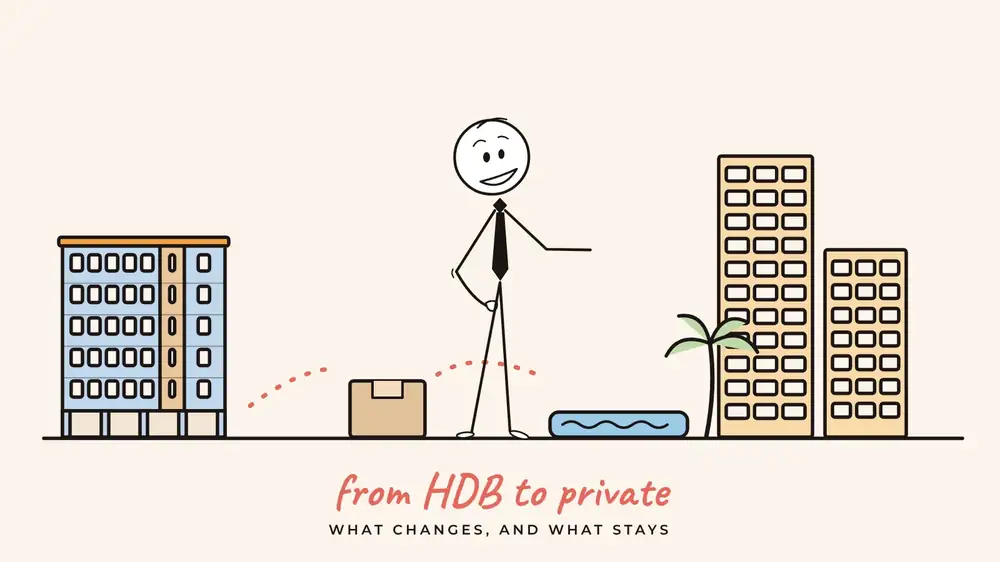
Excited line-art stickman with a moving box, pointing from an HDB block towards a private condo with a pool, showing the move from HDB to private property
Moving from HDB to private changes more than the address. Here is what to expect.

The short answer

The biggest change is not the price of the home. It is the running costs and the rules. A condo adds a monthly maintenance fee, a larger property tax bill and house rules set by its management corporation. In return you get facilities, security and more flexibility, as long as you plan for the extra cost.

A month in each home

The same household, before and after. These are made-up numbers to show how the bill changes, not quotes.

Illustrative

Your HDB flat today

Assumed figures, to show the shape of the bill.

Loan instalment$1,400
Service and conservancy charges$85
Property tax$25
Utilities$250
Monthly total$1,760
Few lines, and the loan is the main one.
Illustrative

A $1,500,000 condo

Assumed figures, with part of the price paid from your flat sale proceeds and CPF, so the loan is smaller.

Loan instalment$3,600
Maintenance fee$400
Property tax$220
Utilities$300
Monthly total$4,520
About $2,760 more a month. The loan is most of it, but the new lines add up too.

Illustrative, assumed figures only. Actual maintenance fees, property tax and utilities differ by development, home size and use. Ask for the real figures for any home you look at, and put them into the worksheet.

Where the maintenance fee goes

In a condo, owners pay two funds, run by the management corporation (MCST). Each owner pays a share, which usually depends on the size of the home.
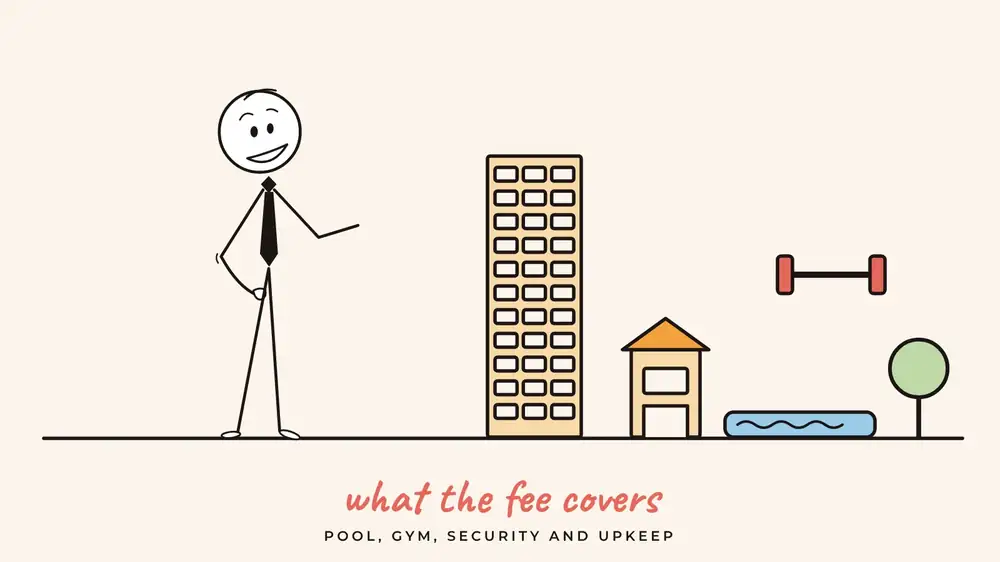
Smiling line-art stickman presenting a condo with a swimming pool, a gatehouse, a gym dumbbell and a tree, showing what a condo maintenance fee pays for
The maintenance fee pays for shared facilities, security and upkeep.
Management fund
Day-to-day running: security, cleaning, lifts, water and electricity for common areas, insurance and routine repairs.
Sinking fund
Saved for big, occasional jobs, such as repainting the development or replacing major shared facilities.

More facilities usually mean a higher fee. A pool, gym and function rooms are paid for by everyone, whether you use them or not, so choose a development whose facilities you will actually use. Fees also differ between developments and can change over time.

What gets easier, and what gets harder

Moving to private is a trade. Here is what usually changes, in both directions.

What usually gets easier
  • Shared facilities such as a pool, gym and function rooms.
  • On-site security and managed common areas.
  • More choice of layouts, sizes and locations.
  • No minimum occupation period, so you are freer to rent out or sell if plans change.
What usually gets harder
  • Monthly running costs, with a maintenance fee and a larger property tax bill.
  • No subsidies for private homes.
  • House rules set through the management corporation.
  • Financing. HDB loans have limits, and a bank loan has its own, set by how much the bank will lend against your income and debts.

The loan limits and extra stamp duties are covered in Sell first or buy first?. If an executive condo is on your list, see Condo or EC.

Add up your new monthly bill

Put in the costs of a home you are considering. You will see the new monthly bill and what is left each month after your other commitments.
Line-art stickman pointing at a large calculator beside a long receipt, showing how to add up the monthly bill of a private home
Add up the full monthly bill before you decide.

Try it

Your new monthly bill
New monthly bill
—
Left each month
—

Use real figures from the home you are considering. Nothing you type is saved or sent. The worksheet checks the same thing at a rate 1% higher.

How the process differs

Buying a private home does not follow the HDB route. Expect these differences.

1
Lawyers and banks run it
A private resale is arranged between the buyer and seller through an Option to Purchase. Your lawyer handles the legal work and your bank handles the loan. It does not go through the HDB resale process.
2
The loan is from a bank
HDB loans are for HDB flats. For a private home you borrow from a bank, and the bank checks your total debts against your income.
3
New launches are paid in stages
Buying from a developer usually means paying in stages while the project is built, so you may pay for the new home while still living in your flat.
4
Timing matters more
Selling your flat and buying the new home do not run on one schedule. See Sell first or buy first?

Your first year in the new home

A simple way to settle in without surprises. These are suggestions, not rules.

Calm line-art stickman with hands behind his head beside three potted plants growing from small to large, showing settling into a new home over the first year
Take your first year in the new home one step at a time.
Before you move
Read the rules
Read the by-laws and ask about renovation hours before work starts.
First month
Learn the place
Find out how to book facilities, and where to report problems.
First 6 months
Check your plan
Compare your real monthly bills with the figures you planned, and adjust your budget if they differ.
First year
Join the meeting
Owners can attend the management corporation’s annual meeting and vote on matters like fee changes and major works.

Myth or fact?

Four things people often assume. Tap each card to see what is really true.

Get ready before you start viewing

Four things to sort out on your side first. Viewing homes is easier, and less tempting, when you already know your limits.

Your budget
Pick a monthly bill you are comfortable with
Use the calculator above, then leave some room for the months when costs run higher.
Your flat
Know roughly what it could sell for
Ask for a recent estimate, and note your MOP date, because it affects when you can sell.
Your loan
Ask a bank what you could borrow
An in-principle view from a bank keeps you from falling for homes you cannot finance.
Your must-haves
Decide what matters most
Location, size, facilities, travel time. Know what you would trade off before you view.

Not sure where you stand? Try the free worksheet, or message me below.

Rules, taxes and rates change. Check current details with HDB, CPF Board, IRAS, MAS and your bank before you decide.

Next step

Put the real monthly costs into your numbers

Add the maintenance fee, property tax and utilities of a home you are considering to the worksheet, then see whether your monthly buffer still holds.

Try the free worksheetTalk it through on WhatsApp
This guide is general information for HDB owners and is not financial, legal or tax advice. Figures and examples are illustrative only.
Jimmy Sum

A real estate professional helping Singapore HDB owners work out their numbers before they upgrade to a condo or EC.

WhatsApp me
Jimmy Sum | CEA Reg No: R026725F | ERA Realty Network Pte Ltd | Licence No. L3002382K
This website is run by a property agent and is not the website of any developer. Project images are artist's impressions. Figures and examples are illustrative only and are not financial advice.
© Jimmy Sum · Privacy · Disclaimer